1- High Chemical corrosion resistance (1<pH<14) .
2- Good Hydraulic system (smooth inner surface) with minimum pressure loss.
3- Inspection friendly (bright inner surface ).
4- Environmentally friendly.
5- Long laying length ( 6 m).
6- Lifetime over 100 years .
7- Excellent impact strength.
8-Good Abrasion resistance.
9- Flexibility and high ring resistance (secure against fracture).
10- High temperature resistance (application from -40 to +80C)
11- Easy handling and installation (light weight, elector-fusion welding system).
12- Cost saving (Handling and installation, maintenance).
13- Resistance to rodents, termites and microorganisms
14- Earthquake proven.
15- UV – Resistance.
16- Material can be recycled to 100%.
17- Ease of transportation due to their low density.
18- Easily and reliable welding in pipe connection.
19- Smooth surface preventing precipitation.
1- High Chemical corrosion resistance
HDPE pipes are made of excellent pipe material with high resistance to corrosive and aggressive chemical environments. Especially significant for sewer applications, HDPE is inert to hydrogen sulphide (H2S), a gas commonly found in sewer lines , also resistant to aggressive soil conditions (pH between 1.0 and 5.0) . DIN EN 13476-1 standard is stated that polyethylene pipes are resistant to corrosion by water with a wide range of pH values such as domestic wastewater, rainwater, surface water and ground water. If the pipes are used for water contaminated by chemical products from industrial discharges, the chemical and thermal resistance has to be considered as per ISO 10358. For buried pipelines the biogeneous sulphuric acid corrosion(H2SO4) plays a key role regarding the longevity of the system. The biogenous sulphuric acid corrosion takes place above the water level and therefore occurs only in partly filled pipes.
2- Good Hydraulic system (smooth inner surface) with minimum pressure loss
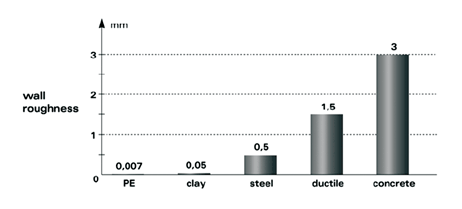
Since HDPE pipes have an extremely smooth surface, the coefficient of friction is very low. This results in a minimal loss of head pressure due to frictional losses. Combined with superior corrosion and abrasion resistant properties of the material, excellent flow properties are maintained throughout the life of the pipe. Inner diameter and hydraulic properties of HDPE pipes will remain constant regardless of he wall thickness or the profiles due to the smooth anti adhesive inner pipe surface.
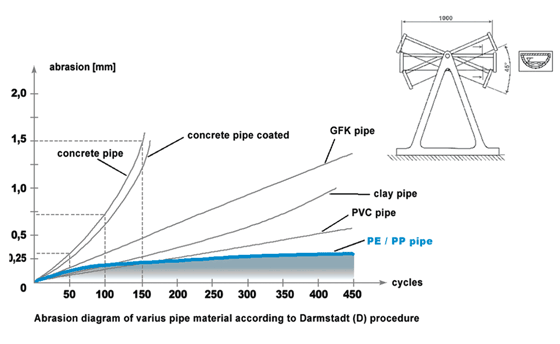
3- Good Abrasion resistance
Polyethylene and polypropylene pipes are among the most abrasion proof pipes. The reference to the test is EN-295 and the results are shown in the diagram below and confirm the quality of HDPE pipes. The abrasion resistance are particularly indicated suitable
4- Excellent impact strength
Many types of inspections and tests (chemical & mechanical) are carried out to guarantee quality of the pipes: checking the composition, the structure and mechanical properties of the metal, dimensions and hydrostatic tests for the pipes.
5- Flexibility and high ring stiffness (secure against fracture).
Pipes made of polyethylene and polypropylene have considerable advantages compared to their pipe materials. One of these advantages is the high flexibility. Even in areas which are highly effected by earthquakes, HDPE pipes are hardly damaged in comparison to pipes made of other materials. HDPE pipes have a great capacity to carry loads, so they are also suitable for road construction.
In radial direction
Elastic pipes can react to changes in their environment. Due to deformation performance, the load is distributed to its surrounding and the force acting on the pipe will be diminished within a short time. There is a balance in the area around the pipeline and the deformation comes to a standstill. Plastic pipes react in a flexible manner towards static loads, while the loads do not concentrate themselves on the pipes, but are diverted to the surrounding soil. Flexible pipes function, even when other rigid pipe systems break.
in axial direction
Since the pipelines are profiled on the outside, these profiled pipes can fix the pipes in the soil. There are very few axial extensions in the pipeline and HDPE pipes are nearly unaffected by temperature variations.
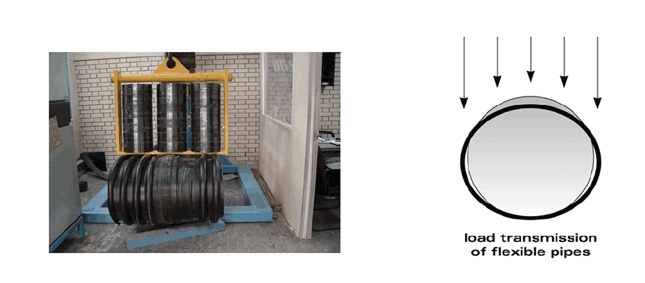
Bending The maximum bending radius depends on the proportion of the pipe wall thickness to the diameter of the pipes. If the proportion is small, maximum bending has to be considered with relation to buckling. If the proportion is larger the maximum expansion of 2.5% (ξ ) should not be exceeded filed pipes can fix the pipes in the soil. There are very few axial extensions in the pipeline and HDPE pipes are nearly unaffected by temperature variations.
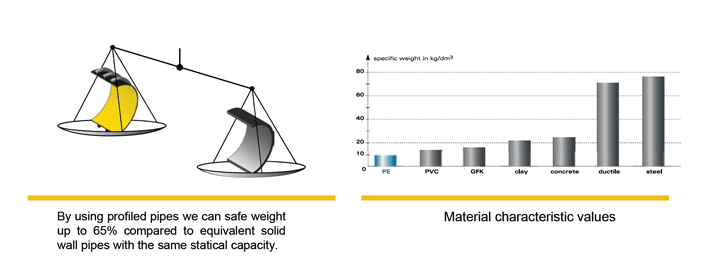
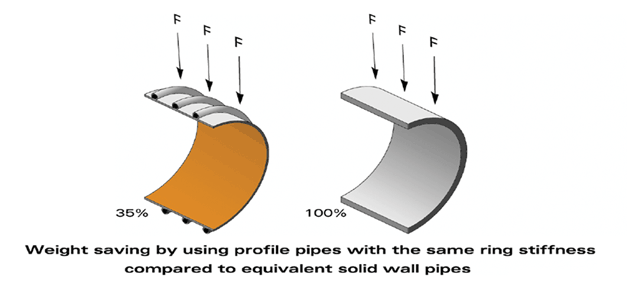
Profile and Stiffness By using a profiled pipe it is possible to use a light pipe for a high static load. The supportable static load is determined for every profile geometry by the factors elastic modulus ( N/mm ) of the respective material and the moment of inertia of the profile geometry ( mm / mm) referring to the pipe diameter. The result is allied ring stiffness. By using a profiled design pipe, the weight can be reduced up to 65% compared to a solid wall pipe with same ring stiffness. Al Bilad pipes offer the best security and durability.
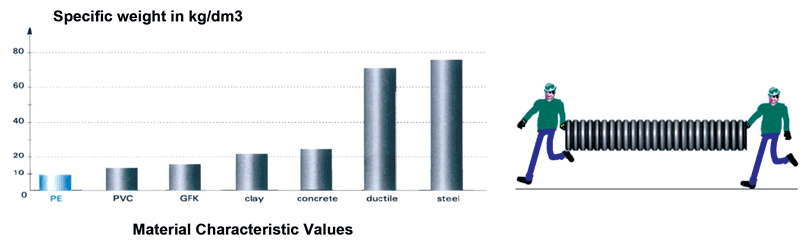
7-Easy handling ,transportation and installation (light weight)
Pipes 500mm dia. and less can be moved manually by a minimum of two people, one at each end. Pipes 600mm diameter and above must be moved using a forklift or an excavator or a loader
8-Cost saving (Weight ,Handling, Installation, Life cycle).
Comparison of design alternatives often employ the use of life cycle economic analyses. The life cycle cost of an alternative system or part of a system anticipates all the costs that are likely to occur over the service life. It includes the costs of the initial investment, inspection as well as scheduled maintenance, repair, rehabilitation and/ or replacement and disruption of services. Another important point is the design of the pipe wall. Earlier very large wall thickness for pipes had to be used in order to maintain loads, which influence the pipe. It resulted in heavy and very expensive pipes although wall thickness stipulated in the norms would be sufficient for the actual application of the pipe. In order to solve this problem the profile pipes have been developed. A profile is added to the minimum required basic wall. The profile is connected to this wall. This profile which is calculated by a special software produces a significant higher moment of inertia and thus the loads can be carried. For comparison, a solid wall pipe of the same material with respective moment of inertia would weigh three times more
9- Resistance to rodents
The smooth round surface of plastic pipes does not give the teeth of rodents sufficient hold to cause damage. Moreover even in termite-affected countries damage to PE pipelines by termites has not been reported. PE and PP are not a nutrient medium for bacteria, fungi and spores, Thus, the material is resistant to all forms of microbial attack as well as to both sumptuous acid and sulphates
10- Earthquake proven.
HDPE pipes will not be damaged by earthquake due to its high flexibility and ring resistance
11- UV – Resistance
Black polyethylene pipes are permanently resistant to atmospheric corrosion and UV adiation. Thanks to the additive of lost carbon black uniformly spread in the polymeric matrix, the pipes can be used and stored outside without damage
12-Material can be 100% recycled.
Polyethylene and polypropylene materials can be 100% recycled. They belong to the group of thermoplastics having the property to be modified dramatically. For this reason they are Eco-friendly and can be used in the production cycle of products which expressly allow the use of such material
13-Easy and reliable welding in pipe connection.
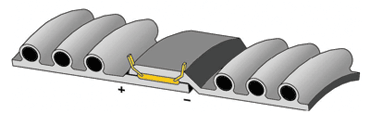
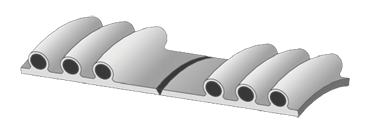
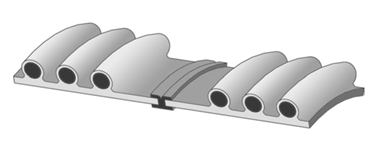
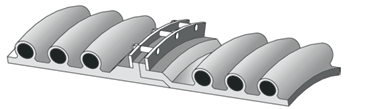
HDPE Pipes and fittings can be connected easily by different welding joint system and by inserting the spigot end in the socket with seal as shown below. Welding methods shall be in accordance with DVS 2207-1 and DVS 2209-1.
|
Electro Fusion Method.
Electro-Fusion method has been a common method in the market for years. It is very favourable because it is simple,fast jointing technique and secure. A welding wire which is fixed in the socket is heated with the help of a special welding devise after pushing the spigot end inside the socket end of the pipes |
|
| Seam Extrusion
Welding Method
Pipes are jointed with the help of a extrusion welding extruder. A welding seam is produced to look like V shape.This method to connect spigot end with another spigot end in accordance with DVS 2207-4 .
|
|
| Butt Welding Method
The pipes are jointed with the help of a heating element butt welding machine. This kind of jointing method is only for pipes with maximum wall thickness of 150 mm in accordance with DVS 2207-1 .
|
|
| Flange Connection The ends of the pipes are jointed with the help of flange steel and rubber gasket. This kind of jointing method is mostly used for lines above the ground and for tank connections
|
|
| Gasket Connection This type of connection is to join the socket with the spigot of another pipe using rubber sealing which is installed into the spigot end of the pipe. The pipe ends should have a minimum stiffness in the spigot and the socket according to prEN 13476 and withstand the test as per prEN 1277 , EN 1053 and ASTM 1417.
|
|
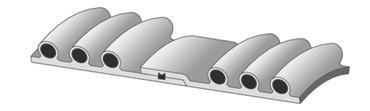
14- Long laying length ( 6m).
The standard laying length of HDPE pipe is six meters. This is advantageous because the pipelines installation time on a site is less limited. Moreover it is possible to deliver 12 m or 18 m of 2 or 3 jointed pipes by Electro-Fusion Method at the factory.
15- Environmentally friendly.
HDPE Pipes do not cause adverse effects.
16- Lifetime over 100 years.
The combination of HDPE positive characteristics results and the latest research suggestion give the service life of HDPE profiled pipes 100 years, even at deflections greater than 5%
.